

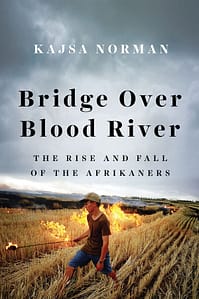
Review of Bridge Over Blood River: The Rise and Fall of the Afrikaners
History is kind to that rare phenomenon, the truly repentant loser. No one exemplifies this better than the Afrikaner people. Apartheid was not just a mistake; it was a terrible one. What followed is now history, with a denouement no one could have predicted. After the eighties, as both internal and external pressures escalated, the Apartheid government could have hunkered down and fought on forever – just like the bittereinders who wanted to keep fighting the Anglo-Boer War. Instead, power was handed over to the ANC, representing the black population and a potential bloodbath was averted. Admittedly, the fall of the Soviet Union and the end of the Cold War was a historic (and rapidly closing) window of opportunity.
The truth is that the Afrikaners, the viciousness of Apartheid notwithstanding, were never truly totalitarian at heart and just lost the will to power. Afrikaners, their leaders stated, had become a middle-class group whose culture and identity would survive in the new Rainbow Nation. Well, it sounded good at the time; such was the relief that South Africa could rejoin the civilised world and, even more important, resume sporting ties.
Twenty-two years after the handover, the exultation (if not self-congratulation) has died out in no uncertain way. The ANC, like all African struggle movements in government, has descended into a quarrelling, corrupt rabble, losing their tenuous grip on the democratic process and determined to hold on to power whatever the cost. It says something that Nigerians have graciously ceded their place as the most corrupt country in Africa to the new folk on the block.
As a group, the Afrikaners are dismissed, if not constantly derided – ANC racism being no less than that which preceded it – and their beloved language under attack, notably in the universities. Of 22 institutions, Stellenbosch is the last university to hold out for all-Afrikaans instruction and this is not likely to last much longer. Those who can get visas are forming a worldwide diaspora. Those who remain are bewildered and dejected, if not bitter and deeply angry. There is much rhetoric about making the best of the situation but, in the age of Jacob Zuma, Julius Malema, the Guptas and University Fallists, only pessimism about the future.
The euphoria gone, serious questions are being asked about the future of the people. The assault on Afrikaans is just the start and many believe they will drift inexorably in the domain of English-speaking whites and later become, horror of horrors, copper-coloured people who have no distinct identity.
So where to for the Afrikaners? An answer to this question is sought by Kajsa Norman, a Swedish journalist with an unusual perspective. While Scandinavian countries firmly opposed Apartheid and supported the ANC, with their Lutheran background they may have more in common with Calvinist Afrikaners than they are prepared to admit. Norman Beards, the former enemy, focuses on two places that epitomise the drastic reversal of fortune. She starts at Orania, that isolated, strange and unique semi-desert settlement in the centre of the country. In addition, she visits a place that, more than anything, stands for the rise and fall of Afrikaner dominance, the scene of their victory over the Zulus that is yearly commemorated: Blood River.
At the Battle of Blood River on 16th December 1838, the Boer forces had an overwhelming victory over the Zulus, freeing them to take over Natal. The victors had made a Covenant with God to build a shrine and treat the day as the Sabbath. Every year, on what would be known as the Day of the Covenant, solemn ceremonies would be held at the site. After 1994, the holiday was changed to Reconciliation Day and a Zulu heritage museum built across the river in 2014. The stakes, it seems, for either side, are too high to compromise and the Blood River bridge stands as a useless monument to the stalemate. According to Norman, this shows how Mandela’s Rainbow Nation has vanished like the morning mists.
Founded by the son-in-law of Dr Verwoerd, and occupied until her death by his wife Betsy, Orania proclaims itself to be an independent republic for the Afrikaner people. No one takes this literally; Mandela and Zuma visited the place to express benign approval. What is unique is the determination to be self-sufficient – that is, racially exclusive in every sense without using African labour. From cleaning the toilet blocks to raking the leaves, every task is done by the white inhabitants. Only in this way will they be able to create a haven for their people to maintain their exclusive cultural, linguistic and social lives.
Despite intense scepticism from other South Africans, Orania has not just held its own, but is expanding and plans to set up another coastal settlement. Its agriculture projects are doing well and visitors are impressed by the neat, organised layout, the courteous demeanour of the residents and absence of tension. Of course, there is a strong emphasis on religious piety and disciplined behaviour – miscreants can, and often are expelled – but nothing to indicate the oppression of a cult.
Orania’s veneration for the glorious leaders is maintained in a rather forlorn way. On a small hillock stands a collection, a veritable Karoo glyptotheca, of statues of the Afrikaner prime ministers. The apex of the collection is the bust of the man who made it all happen, the high priest of Apartheid, Dr Hendrik Verwoerd. The problem is that they ran out of money when commissioning the statue, so it is less than half the intended size, which somewhat ruins the effect.
As a welfare project, Orania is outstanding. Most of the men who come there are the surviving white wrecks of the Apartheid endeavour. Whereas their Afrikaner status would have guaranteed them a job for life in the public sector, chiefly the railways, this all vanished, leaving them woefully unprepared for life in the new South Africa. Family breakdowns, alcoholism, drug abuse and sheer ineptitude reduced them to penury, often living in the streets. Welcome to the world that blacks had lived with for generations, some would say, but being on the wrong side of history has left them utterly stranded.
Orania, in its own way, is repeating a community activity of a century ago. A broken people after losing the war to the British, driven off their land, Afrikaners flocked to the cities where they became known, in a term that sums up the racial preoccupations of the country, as the poor white problem – it is self-evident why no one used the term poor black problem. A range of social and community organisations was set up to alleviate their poverty with a strong focus on retaining Afrikaner identity and supporting the church. The racial element was pronounced, and there was constant concern about intermarriage in the inner-city suburbs where the races mixed freely. This made the rise of the National Party inevitable and, after achieving government in 1948, they were determined to create the Afrikaner republic.
Norman interviews Hermann Giliomee, the leading historian of his people. The Afrikaner leaders betrayed their people in the handover of power, he states. The much-lauded constitution had no consideration of group rights. Now it is all too evident that there is no protection and, worse, no will, to protect the Afrikaners and he fears the worst.
Norman examines the antipodes, as it were, the two places that symbolise Afrikaner future without triumphalising or moralising. The mask does slip at times and she can’t resist the odd shot about the innate racism of whites, to say nothing of their scepticism about a democratic (eg., black) country being run properly.
What are we left with? Orania, good intentions notwithstanding, only applies to a small segment of the people; it will never be a solution for the Afrikaner majority of rural farmers and urban dwellers. The problem is not that power has passed to the utterly debauched ANC; it is that the structures that hold it together are slipping away. Eventually it will just run loose and the deluge, feared for so long, will become a reality. The grimmest view is that it will be a reprise of Zimbabwe, across the border. Once the breadbasket of Africa, now there is a brutal political tyranny, hyperinflation of Weimar standards and mass starvation.
Norman has summed up the dilemmas of the White Tribe of Africa rather neatly and this book should be read by anyone interested in the fate of those who stand on the wrong side of history. The future of the Afrikaners is not necessarily as gloomy as some predict. A century ago they raised themselves from the devastation of the Anglo-Boer War to a remarkable level of success, albeit at the expense of the black population. A resilient people with great self-belief are not vanquished that easily – and don’t forget the Calvinism.
Kajsa Norman. Bridge Over Blood River: The Rise and Fall of the Afrikaners. Hurst Publishers, 2014.
Robert M. Kaplan visits South Africa regularly to bother historians, archaeologists and palaeontologists about their discoveries of its amazing past.